
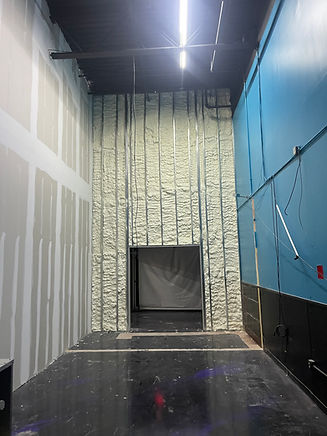
Commercial Insulation
Engineered Specifically for Commercial Structures & High-Performance Environments
01
Commercial Applications of Insulation Materials
Commercial buildings require durable, high-efficiency insulation solutions that meet strict energy codes, safety regulations, and environmental standards. Depending on the building’s function—whether it’s a warehouse, office, medical facility, or retail center—different types of insulation are selected to manage temperature, reduce noise, and prevent moisture intrusion. Materials like closed-cell spray foam, rigid foam boards, mineral wool, and fiberglass batts are commonly used for their proven performance in demanding commercial environments.
02
Common insulation materials used in commercial projects:
-
Closed-cell spray foam – High R-value, moisture barrier, and structural reinforcement.
-
Open-cell spray foam – Air sealing and sound control in interior wall systems.
-
Fiber-Glass – some type have fire resistant and are ideal for sound control - ( Rock wool)
-
OCX spray foam Insulation – Fire-resistant and code complaint for commercial spaces
02
Open Cell Insulation Solutions
Commercial insulation is a critical component in the overall performance and sustainability of modern buildings. It is strategically installed to regulate internal climate conditions, minimizing temperature fluctuations and reducing the load on HVAC systems. By effectively sealing building envelopes, insulation helps prevent air leakage and heat transfer, significantly lowering energy consumption and operational costs. In industries such as healthcare, education, retail, and manufacturing, maintaining consistent indoor temperatures is not just a comfort issue—it’s essential for protecting equipment, preserving product integrity, and creating a safe and productive environment for occupants.
04
Common commercial applications include:
-
Office buildings and retail centers
-
Hospitals and medical labs
-
Schools and universities
-
Warehouses and distribution centers
-
Mechanical rooms and duct systems
Commercial Insulation
Commercial insulation refers to thermal, acoustic, and moisture-control materials specifically designed for use in commercial buildings such as offices, warehouses, retail centers, hospitals, schools, and industrial facilities. These systems are engineered to meet stringent building codes, improve energy efficiency, enhance occupant comfort, and reduce long-term operating costs. Commercial insulation must be durable, high-performing, and often fire-rated or moisture-resistant to meet the unique needs of large-scale, high-traffic, or specialty-use spaces.
Why It’s Essential: 3 Advantages for Building Performance
Energy Savings
Insulation helps regulate heating and cooling loads, reducing energy consumption and lowering monthly utility bills, an essential factor in managing costs for large-scale facilities.
Code Compliance
Meets or exceeds building code requirements (e.g., R-values, fire resistance, and vapor barriers), supporting legal compliance and eligibility for green building certifications like LEED®
Fire Protection
Certain commercial insulation materials are fire-rated to help slow the spread of flames, protect critical infrastructure, and improve overall building safety.

The Process
Installing commercial insulation is a multi-step process that begins with a detailed site assessment. Professionals evaluate the building’s layout, energy goals, and specific thermal or acoustic requirements. Once the proper materials are selected such as rigid foam boards, fiberglass batts, spray foam, or blow-in insulation technicians prepare the surfaces by sealing gaps, installing vapor barriers if needed, and ensuring the area is ready for insulation. Application techniques vary depending on the material but typically involve mechanical fastening, spraying, or blowing insulation into wall cavities, ceilings, roofs, or mechanical systems. After installation, thorough inspection and sealing are performed to ensure all gaps are filled and the insulation meets local codes and performance standards.
Process Overview:
-
Assessment – A professional audit determines insulation needs based on building type and use.
-
Material Selection – Contractors choose the right type of insulation (e.g., spray foam, rigid board) for optimal results.
-
Installation – Insulation is applied to walls, ceilings, roofs, or mechanical areas using appropriate tools and methods.
-
Inspection & Sealing – Final walkthrough ensures full coverage, code compliance, and airtight sealing.